
Table of Contents
If you’re swiping cards at grocery stores without thinking, watching your bank account drain mysteriously throughout the month, and wondering where all your money went when bills are due, this is for you.
You know that moment when you check your bank balance and realize you’ve somehow spent $400 more than planned this month, but you can’t figure out where it went? Every transaction seemed reasonable in the moment – groceries, gas, a few household items – but somehow those “small” purchases added up to budget disaster without you even noticing.
You’ve tried budgeting apps. You’ve attempted to track spending mentally. You’ve made promises to yourself about being more careful with money, but when you’re standing in Target with your debit card, those promises feel abstract while that cute throw pillow feels very real and reasonably priced.
Here’s what changed everything for me: I stopped trusting myself with unlimited access to my bank account and started using cash envelope budgeting to create physical boundaries around my spending. This isn’t about being extreme or never using modern banking – it’s about using tangible limits to prevent financial self-sabotage.
This simple cash envelope budgeting system makes overspending literally impossible while taking away the mental exhaustion of constantly trying to track every purchase. When the cash is gone, the spending stops. It’s budgeting with built-in enforcement.
Why Cash Envelope Budgeting Is Revolutionary
The genius of cash envelope budgeting isn’t that it restricts spending – it’s that it makes spending visible and finite. When you can see exactly how much money you have left for groceries, you make different choices than when spending feels unlimited and abstract.
Traditional budgeting relies on tracking after the fact and hoping you’ll remember to check balances before purchases. Cash envelope budgeting prevents overspending in real-time by creating physical boundaries that you can’t accidentally cross.
Plus, cash envelope budgeting removes the mental load of constantly calculating whether you can afford something. When you see $50 left in your grocery envelope, you know exactly what you’re working with without checking apps or doing math.
The 6-Step Cash Envelope Budgeting System That Works
1. Calculate Your Category Amounts
What you do: Determine exactly how much you want to spend in specific categories each month – groceries, gas, dining out, household items, personal spending.
Why it’s crucial: This step of cash envelope budgeting forces you to be realistic about your spending patterns and make intentional choices about priorities.
Pro tip: Start with tracking one month of current spending to establish realistic baseline amounts rather than aspirational numbers you’ll never stick to.
2. Create Physical Envelopes
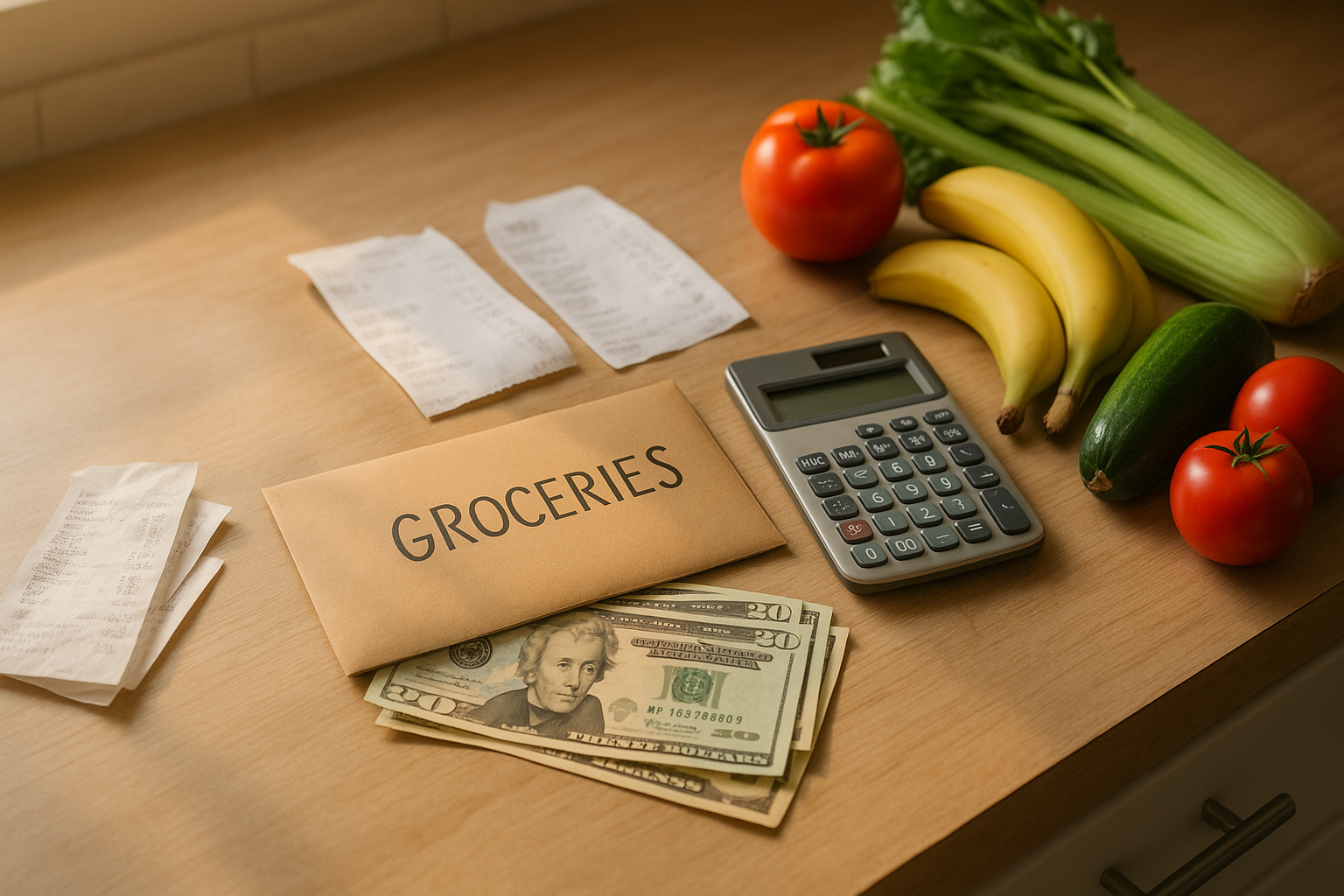
What you do: Label envelopes for each spending category and decorate or organize them in a way that makes you want to use the system.
Why it works: Physical envelopes make cash envelope budgeting tangible and harder to ignore than digital tracking systems. You’re handling real money for real purchases.
The setup: Use regular envelopes, a small accordion file, or a dedicated cash envelope wallet – whatever system you’ll actually use consistently.
3. Fill Envelopes at the Start of Each Period
What you do: Visit the bank and get cash to fill your envelopes according to your predetermined amounts. This usually happens monthly or biweekly based on your pay schedule.
Why it’s powerful: This cash envelope budgeting step creates a ritual that reinforces your commitment to the budget and makes spending limits feel real.
The psychology: Physically handling the money you’ve allocated creates stronger mental connection than digital transfers.
4. Spend Only from the Appropriate Envelope
What you do: When you go grocery shopping, bring only the grocery envelope. When you get gas, use only gas money. Each purchase comes from its designated envelope.
Why it’s genius: This cash envelope budgeting rule prevents category blending that destroys most budgets. Entertainment money can’t accidentally become grocery money.
The discipline: If an envelope is empty, you’re done spending in that category until next month or until you consciously decide to reallocate from another envelope.
5. Track What’s Working and What’s Not
What you do: Notice which envelopes consistently run out early and which ones have money left over. Adjust amounts based on actual spending patterns.
Why it’s essential: Cash envelope budgeting is most effective when amounts match your real life rather than your ideal life. Adjust the system to serve you better.
The learning: This isn’t about perfect budgeting from day one – it’s about creating a sustainable system that evolves with your needs.
6. Handle the Leftover Money Strategically
What you do: Decide in advance what happens to money left in envelopes at month’s end – does it roll over, go to savings, or get reallocated to other categories?
Why it matters: This final step of cash envelope budgeting prevents the system from falling apart when you underspend in some categories.
The options: Roll over to next month for that category, move to a savings envelope, or redistribute to categories that consistently run short.
The Psychology Behind Why Cash Envelope Budgeting Works
Understanding the mental mechanisms makes this system much more powerful:
Loss aversion: People feel the pain of parting with physical cash more acutely than swiping cards. This natural psychological tendency helps control spending without willpower.
Visual feedback: Seeing money decrease in real-time provides immediate feedback about spending decisions, unlike delayed digital tracking.
Finite resources: When you can physically see that you only have $30 left for groceries, you naturally become more strategic about purchases.
Decision simplification: Instead of complex mental calculations about whether you can afford something, you just check if there’s enough cash in the relevant envelope.
Adapting Cash Envelope Budgeting for Modern Life
For online shopping: Keep some money in checking for necessary online purchases, but transfer equivalent amounts out of relevant envelopes to maintain the system.
For safety concerns: Use cash envelope budgeting for discretionary spending while keeping fixed bills on automatic bank payments.
For credit card rewards: Some people use credit cards but follow cash envelope rules, paying off cards immediately and tracking as if using cash.
For irregular income: Adjust envelope amounts based on actual income each period rather than trying to maintain consistent amounts.
For family coordination: Each adult can have their own set of envelopes, or couples can share category envelopes with clear communication about usage.
Your Cash Envelope Budgeting Starter Kit
Physical Organization:
- Labeled envelopes – sturdy enough for regular handling
- Cash envelope wallet – keeps everything organized and portable
- Calculator – for quick math when shopping
- Pen and paper – for tracking spending within categories if desired
Planning Tools:
- Budget worksheet – to determine realistic category amounts
- Spending tracker – one month of current spending to establish baselines
- Bank relationship – easy access to cash without excessive ATM fees
- Emergency fund – separate from envelope system for true emergencies
Success Supports:
- Family buy-in – everyone needs to understand and support the system
- Backup plan – what to do when envelopes run out early
- Motivation reminders – visual cues about why you’re using this system
- Review schedule – regular check-ins to adjust amounts as needed
Troubleshooting Common Cash Envelope Budgeting Challenges
Problem: Always running out of grocery money Solution: Track exactly what you’re buying for two weeks, then either increase the grocery envelope or identify specific spending leaks.
Problem: Feeling restricted or deprived Solution: Make sure your amounts are realistic, and include a “fun money” envelope for guilt-free discretionary spending.
Problem: Family members not following the system Solution: Start with your own spending first, then gradually introduce family members to categories that affect them directly.
Problem: Inconvenience of carrying cash Solution: You don’t need to use cash envelope budgeting for every category – focus on your biggest problem spending areas.
Problem: Safety concerns about carrying cash Solution: Only take what you need for specific shopping trips rather than carrying all envelopes everywhere.
Advanced Cash Envelope Budgeting Strategies
The Seasonal Approach: Adjust envelope amounts based on predictable seasonal changes – higher grocery budgets during holidays, increased gas money during vacation months.
The Sinking Fund Integration: Use additional envelopes for irregular expenses like car maintenance, gift giving, or annual insurance premiums.
The Digital Hybrid: Use cash envelope principles with digital tools for tracking while maintaining some physical cash envelopes for high-temptation categories.
The Percentage System: Base envelope amounts on percentages of income rather than fixed amounts, making the system adaptable to income fluctuations.
The Challenge Method: Start with very tight envelopes for one month to see minimum spending levels, then adjust upward for sustainability.
The Real Math: How Much Cash Envelope Budgeting Saves
Let’s look at actual savings because they can be substantial:
Reduced impulse spending: Studies show people spend 12-18% less when using cash instead of cards Category awareness: Prevents spending category bleed that typically adds 15-20% to budgets Fee avoidance: Eliminates overdraft fees and reduces credit card debt accumulation
Example calculation: If you currently spend $3,000/month on variable expenses, cash envelope budgeting could reduce spending by:
- Impulse control improvement: $360-540/year
- Category discipline: $450-600/year
- Fee elimination: $200-400/year
Total potential annual savings: $1,010-1,540
Plus the psychological benefits of reduced money stress and increased financial confidence.
When Cash Envelope Budgeting Needs Modification
Income changes: Adjust envelope amounts proportionally rather than abandoning the system during financial changes.
Life stage shifts: New babies, job changes, or housing moves require recalibrating category amounts and priorities.
System fatigue: If the novelty wears off, try digital versions or reduce the number of categories rather than giving up entirely.
Security concerns: Modify the system for your comfort level – perhaps use cash for groceries but cards for gas stations.
The Ripple Effects of Cash Envelope Budgeting
Once this system becomes routine, positive changes happen beyond just spending control:
Financial awareness increases: You become naturally more conscious of prices, value, and spending patterns.
Debt reduction accelerates: When spending is controlled, more money becomes available for debt payments.
Savings goals become achievable: Controlled spending creates room in the budget for systematic saving.
Money stress decreases: Knowing exactly what you can afford eliminates constant financial anxiety.
Family communication improves: Shared envelope systems require coordination and create opportunities for financial discussions.
The Real Talk About Cash Envelope Budgeting
This system won’t solve all your financial problems or make budgeting effortless. What it will do is create automatic spending limits that prevent the most common budget failures – gradual overspending that adds up to significant financial stress.
The best part about cash envelope budgeting is that it works with human psychology rather than requiring superhuman discipline. When physical limits prevent overspending, you don’t have to rely on willpower in moments of temptation.
I’ve been using cash envelope budgeting for years, and it’s completely changed my relationship with money. Instead of constantly worrying about spending, I know exactly what I can afford and spend it without guilt.
When Cash Envelope Budgeting Becomes Natural
After using this system for a few months, handling cash becomes automatic rather than inconvenient. You start naturally thinking in terms of envelope categories when making spending decisions.
The physical act of handling money creates stronger spending awareness that persists even when you occasionally use cards. You’ve trained your brain to consider category limits and spending consequences.
Eventually, you’ll find that even when you don’t use physical envelopes, you naturally think in cash envelope terms about spending decisions.
The Bottom Line
Cash envelope budgeting isn’t about being old-fashioned or rejecting modern banking. It’s about using physical limits to create automatic spending control that doesn’t require constant mental energy and willpower.
When you can see and touch your spending limits, budgeting becomes concrete rather than abstract. When categories have physical boundaries, overspending becomes literally impossible rather than just inadvisable.
The next time you’re wondering where all your money went this month, consider that maybe the problem isn’t your spending choices – it’s the lack of visible, physical limits on those choices.
Because life’s too expensive to rely on willpower alone when managing money, and your financial peace of mind deserves better protection than hoping you’ll remember to check your bank balance before every purchase.