Table of Contents
If your closets are bursting, your kids’ toy boxes are overflowing, and you can’t find counter space in your kitchen because every gadget you’ve ever bought is still taking up residence there, this is for you.
You know that sinking feeling when you bring home something new and realize you have nowhere to put it because every drawer, shelf, and cabinet is already stuffed to capacity. You start playing Tetris with your belongings, trying to squeeze one more thing into spaces that are already maxed out. Before you know it, you’re living in a house where storage has become a contact sport.
You’ve tried organizing. You’ve bought more containers. You’ve rearranged closets and shuffled things around. But somehow, no matter how much you organize, the clutter keeps multiplying like rabbits until you feel like you’re drowning in your own possessions.
Here’s what changed everything for me: I stopped trying to organize infinite amounts of stuff and started controlling how much stuff comes into my house in the first place. The one in one out rule isn’t just about organization – it’s about preventing clutter instead of constantly fighting it.
This isn’t about living like a minimalist monk or never buying anything fun again. This is about creating a sustainable system where your house doesn’t keep expanding beyond its physical limits while you slowly lose your mind trying to find places for everything.
Why the One In One Out Rule Is Pure Genius
The magic of the one in one out rule isn’t that it forces you to get rid of things – it’s that it makes you think before you acquire things. When you know that bringing something new home means something else has to leave, you naturally become more selective about what deserves space in your life.
Traditional decluttering happens after you’re already overwhelmed by too much stuff. The one in one out rule prevents overwhelm by maintaining equilibrium. Your house stays at a manageable capacity instead of slowly expanding until every surface is covered and every closet is stuffed.
Plus, the one in one out rule actually makes you appreciate what you have more. When you have to choose what to keep versus what to release, you start recognizing which items truly add value to your life and which ones are just taking up space.
7 Ways to Master the One In One Out Rule
1. The Immediate Swap System
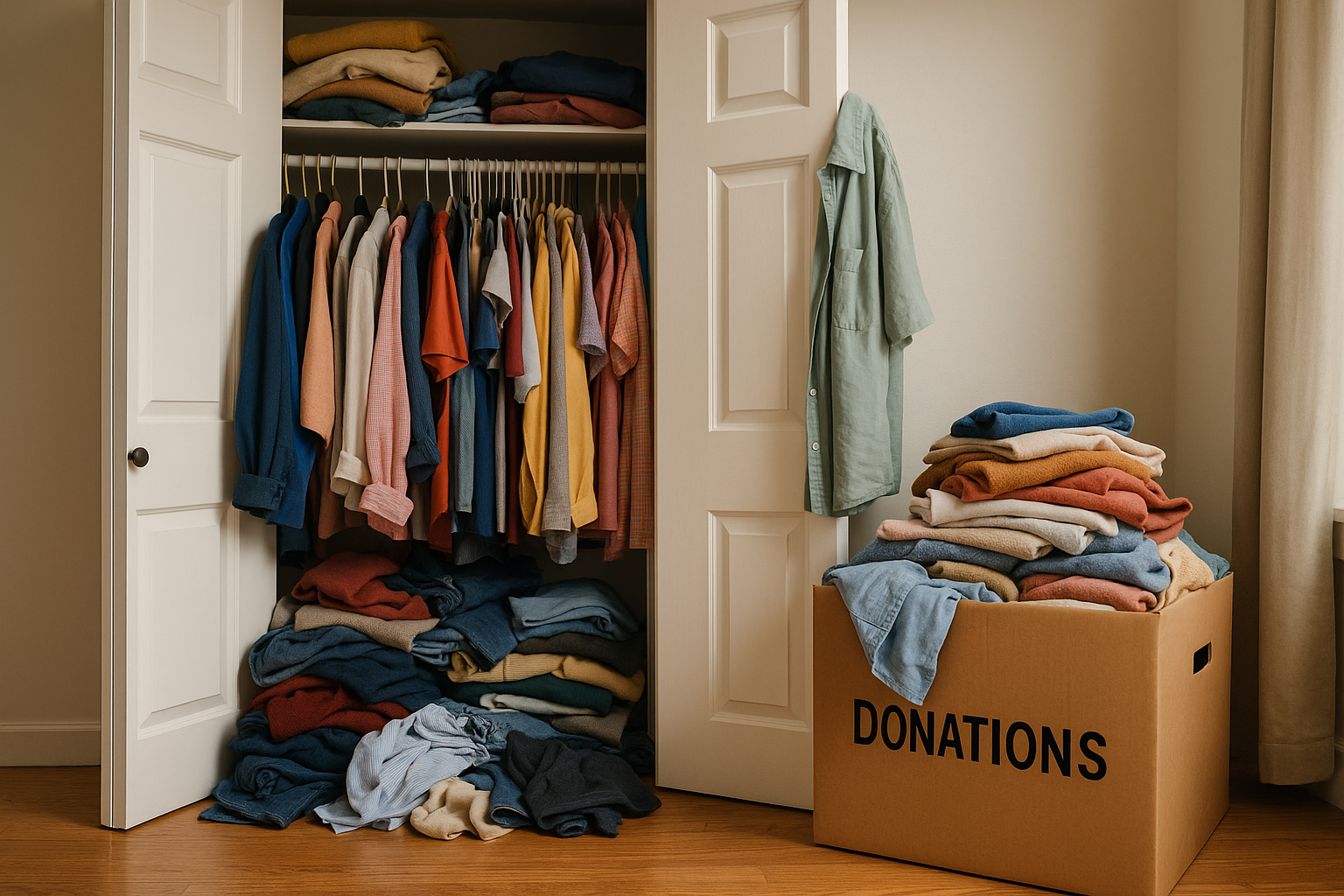
How it works: Before you even put a new purchase away, identify what it’s replacing. New shirt? Old shirt goes in the donation bag immediately. New kitchen gadget? Something else leaves the kitchen that same day.
Why it’s genius: This version of the one in one out rule prevents the “I’ll deal with it later” mentality that leads to accumulated clutter. The transaction is complete when the swap is complete.
Perfect for: People who tend to procrastinate on decluttering or who forget about the “out” part of the equation.
2. The Category-Based Approach
How it works: Apply the one in one out rule within specific categories. New book means an old book leaves. New toy means an old toy gets donated. New kitchen tool means another tool finds a new home.
Why it works: This prevents category creep where your book collection slowly takes over your house or your kid’s toys multiply beyond any reasonable container capacity.
Best for: Families with specific problem areas – like book lovers, toy collectors, or kitchen gadget enthusiasts.
3. The End-of-Season Purge
How it works: At seasonal transitions, apply the one in one out rule retrospectively. Bought three new sweaters this fall? Three old ones need to go before winter storage.
Why it’s effective: This version of the one in one out rule works with natural shopping patterns and gives you built-in evaluation points throughout the year.
Great for: People who shop seasonally or who struggle with daily decision-making but can handle periodic larger purges.
4. The Family Member Assignment
How it works: Each family member manages their own one in one out rule for their personal belongings. Kids learn to evaluate toys before getting new ones. Adults apply it to their clothing, hobbies, and collections.
Why it’s smart: This teaches everyone to be conscious consumers while preventing one person from being the household “declutter police.”
Perfect for: Teaching kids about conscious consumption and giving everyone ownership of their own stuff management.
5. The Space-Limited Method
How it works: Designate specific containers or spaces for categories of items. When the container is full, the one in one out rule automatically kicks in. New item can’t fit unless something else leaves.
Why it works: This version of the one in one out rule creates physical boundaries that are easier to see and follow than abstract rules.
Best for: Visual people who need concrete limits, or families who struggle with subjective decisions about “too much stuff.”
6. The Quality Upgrade System
How it works: Use the one in one out rule as an opportunity to upgrade. When you buy something new, release the lower-quality version of the same item.
Why it’s brilliant: This approach actually improves your quality of life while maintaining the same amount of stuff. You’re trading up instead of just trading out.
Great for: People who want to gradually improve their possessions without accumulating more volume.
7. The Gift and Inheritance Protocol
How it works: Apply the one in one out rule even to items you didn’t purchase. Received gifts, inherited items, and freebies all trigger the same decision process as purchases.
Why it’s necessary: Gifts and free items can derail decluttering efforts faster than purchases because we feel guilty releasing them. This version of the one in one out rule treats all incoming items equally.
Essential for: People who receive lots of gifts, inherit family items, or have trouble saying no to free things.
The Psychology Behind Why the One In One Out Rule Works
There’s real science behind why this system is so effective. When we have unlimited space (or think we do), we make different decisions than when we know space is finite. The one in one out rule creates artificial scarcity that forces more thoughtful consumption.
The rule also prevents the mental exhaustion that comes from constantly managing too much stuff. When your possessions stay at a manageable level, you spend less mental energy on organization and more energy on actually enjoying your things.
Plus, the one in one out rule builds decision-making muscles. The more you practice evaluating what to keep versus what to release, the better you get at recognizing what truly adds value to your life.
Adapting the One In One Out Rule for Different Situations
For sentimental items: Allow yourself a designated memory box or space. When it’s full, apply the one in one out rule within that container.
For children’s belongings: Start with a modified version like “two in, one out” to ease them into the concept, then gradually work toward true one-for-one trading.
For hobby supplies: Apply the rule within hobby categories rather than across all hobbies. New craft supply means old craft supply goes, but doesn’t affect sports equipment.
For seasonal items: Manage holiday decorations, summer gear, and winter clothes with seasonal applications of the one in one out rule.
For shared spaces: Create household rules for common areas while allowing individual flexibility for personal spaces.
Your One In One Out Rule Toolkit
Decision-Making Aids:
- Donation bags – keep one in each closet for immediate swaps
- “Maybe” box – for items you’re unsure about removing permanently
- Photo documentation – take pictures of sentimental items you’re releasing
- Evaluation questions – written criteria for keeping vs. releasing items
Physical Boundaries:
- Container limits – designated baskets or boxes for specific categories
- Shelf space – assign specific shelves for certain types of items
- Hanging space – use closet capacity as natural one in one out rule enforcement
- Drawer organizers – create defined spaces that can’t expand infinitely
Tracking Tools:
- Shopping pause – 24-hour rule before bringing new items home
- Purchase log – track what comes in to ensure something goes out
- Family agreement – written rules everyone understands and follows
- Regular check-ins – monthly reviews of how the system is working
When the One In One Out Rule Gets Challenging
Holiday and birthday seasons: Prepare donation bags before gift-receiving events. Make releasing items part of the celebration ritual.
Sales and bargains: Remember that a good deal on something you don’t need isn’t actually a good deal. The one in one out rule helps resist impulse purchases.
Sentimental resistance: Allow yourself reasonable memory-keeping while recognizing that keeping everything diminishes the specialness of truly meaningful items.
Family pushback: Start with your own belongings before implementing household-wide rules. Lead by example rather than enforcement.
Inherited items: Give yourself time to process emotional attachments, but don’t let inherited items derail your entire system.
Making the One In One Out Rule Sustainable
Start small: Begin with one category or one room rather than trying to implement the rule everywhere at once.
Be realistic: The goal is balance, not perfection. If you occasionally bring in two items and remove one, that’s still progress.
Celebrate wins: Acknowledge when the system prevents purchases or when releasing items feels good rather than painful.
Adjust as needed: Modify the rule to fit your life rather than forcing your life to fit rigid rules.
Focus on benefits: Remember that the one in one out rule creates more space, less stress, and easier maintenance of your home.
The Ripple Effects of Living the One In One Out Rule
Once this system becomes habit, amazing changes happen beyond just having less clutter:
Shopping becomes more intentional: You naturally evaluate purchases more carefully when you know they require releasing something else.
Cleaning becomes easier: When you have fewer possessions, maintaining order requires less time and energy.
Moving becomes manageable: Whether you’re rearranging rooms or relocating entirely, fewer belongings make everything simpler.
Financial awareness increases: You start noticing how much money you save when you’re not constantly acquiring new things.
Decision fatigue decreases: When you own fewer items, daily choices about what to wear, use, or organize become simpler.
The Real Talk About the One In One Out Rule
This system won’t transform you into a minimalist overnight, and it won’t solve all your organization problems. What it will do is prevent your possessions from expanding beyond your ability to manage them comfortably.
The best part about the one in one out rule is that it works with human nature rather than against it. Instead of requiring superhuman discipline or major lifestyle changes, it just adds one small consideration to acquisition decisions.
I’ve been using the one in one out rule for years, and it’s completely changed my relationship with shopping and organizing. Instead of constantly fighting clutter, I maintain equilibrium with minimal effort.
When One In One Out Becomes Second Nature
After following this system for a few months, something shifts in your thinking. You start automatically evaluating new purchases against what you already own. You naturally gravitate toward quality over quantity because you know each item needs to earn its place.
The rule becomes less about restriction and more about intention. You’re not depriving yourself – you’re making conscious choices about what deserves space in your life.
Eventually, you’ll find yourself helping friends and family implement their own versions of the one in one out rule because you’ve experienced how much mental space it creates when your physical space stays manageable.
The Bottom Line
The one in one out rule isn’t about living with less for the sake of minimalism – it’s about living with the right amount for the sake of sanity. When your possessions stay within your space’s capacity, maintenance becomes manageable instead of overwhelming.
When you master this system, you stop feeling like your house is expanding beyond your control. When you know that every new item has been consciously chosen to replace something else, you feel intentional about your possessions rather than buried by them.
The next time you’re about to bring something new into your house, ask yourself: what’s going to leave to make room for this? You’ll be amazed how that one question transforms your relationship with both acquiring and releasing possessions.
Because life’s too short to spend it managing more stuff than your space can handle, and your home should feel like a sanctuary, not a storage unit with a bed.